Vibe Coding from Telegram: It Actually Works

So lately I’ve been building software from Telegram. Just chatting with an AI on my phone, and PRs show up on GitHub.
The stack is Claude Opus running through OpenClaw. I’ve got a coding agent named Kodi that handles the dev work.
What I Built
I built an income-expense tracker with an API and an AI-first approach in mind. I’ve used a lot of money trackers in the past, but I always had one big problem: manually inputting things. I did it for several months: when I got my salary, I’d input it manually, but then the numbers wouldn’t match. That’s a whole other headache trying to reconcile everything.
Then I tried to automate things using n8n. What I did was connect expense email notifications from my bank to n8n. It looked okay at first, but not in the long run. Sometimes it’d miss one or two transactions. That’s another headache to reconcile things (again).
This has been a long-running problem for me. You can’t really make it fully automatic, and it’s also hard to stay consistent with manual input. I’m trying to solve that with this personal vibe-coding project.
Here’s what I want the workflow to look like:
- Hand the finance agent a bank statement PDF
- Agent parses it, stores the data somewhere to log transactions
- PDF gets deleted after processing
The key is that AI parses the data directly from the bank statement PDF every month. With AI capabilities right now, I think it can parse a PDF pretty well. But the next thing I need to do is input that data somewhere, right? So I created the app, Koin. Then the next question becomes: how do I connect the finance agent to the app? SKILLS is the answer.
So the app needs to be API and AI-first.
At the end of the day, the data stays in Koin. The agent only helps parse the data and send it to the app — no files hang around.
The Workflow
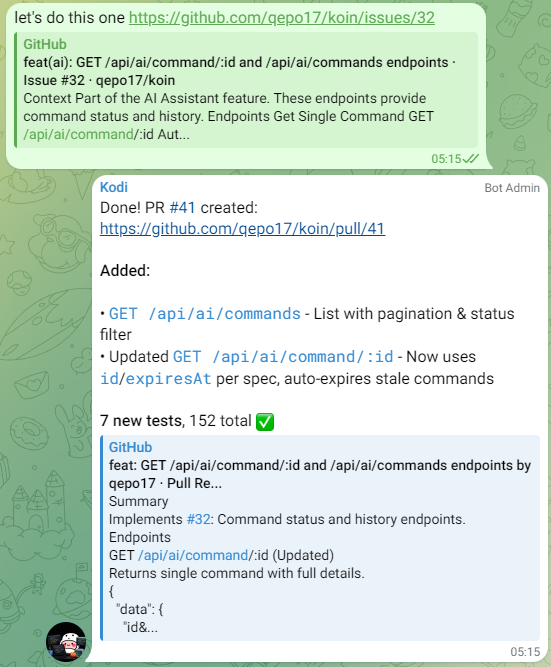
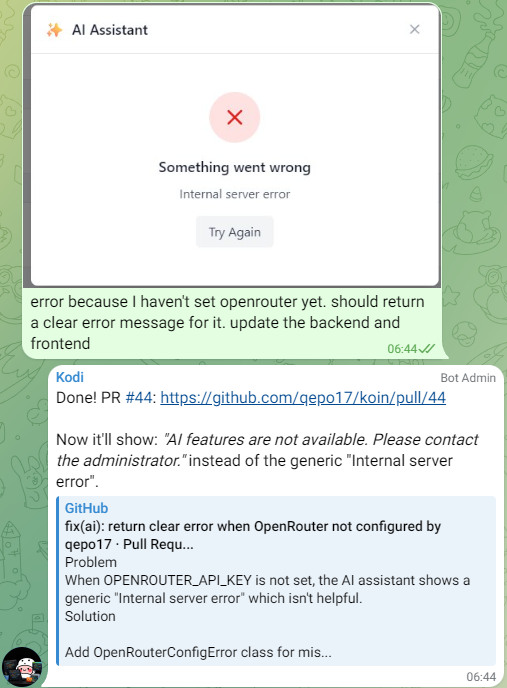
So what does building look like?
- Ask the agent to build or fix something
- It writes code, creates a PR
- I review
- Ask for changes if needed
- Tell it to merge
All through chat. Git, commits, PR descriptions — the agent handles it: I just talk. I’m a bit surprised at how seamless the flow is. The agent is very smart and can follow instructions perfectly. I rarely got an error or found a case where he misbehaved outside of instructions. I told him to do something, and he can do it.
🧑 “I have an idea to build [a product], please create a plan for it.”
🤖 “[Here’s the plan]”
🧑 “I think [you should revise this-and-that part].”
🤖 “[Updated the plan]”
🧑 “Ok, looks cool now. Split the feature into smaller tasks. You can create GitHub issues for it.”
🤖 “[10 issues created]. Want to do #1 next?”
🧑 “Let’s do it.”
That’s it. Honestly, I’m impressed.
Testing It
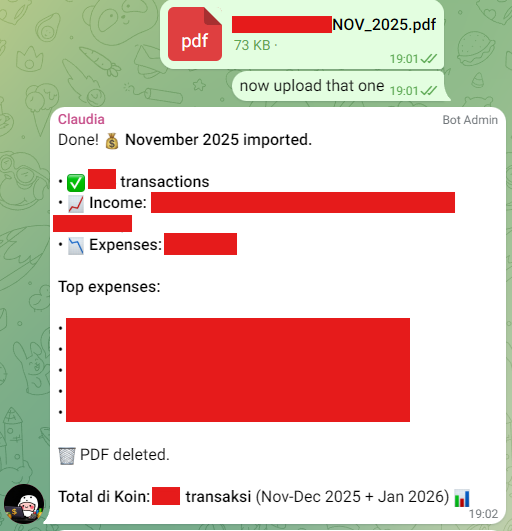
So for testing, I used another agent in the same OpenClaw instance as Kodi — one called Claudia.
I made Claudia specifically to manage my finances, so she’s the one I threw the bank statement at. Before installing the Koin skill, I already had a bank-statement-parser skill installed. I made that one to handle parsing the statement specifically. Then I tried it:
- Threw the bank statement
- Claudia parses it
- Automatically sends everything to Koin
- Checked the transaction numbers — accurate
- Happy
Embrace the Slop
Look, I get it, the codebase is probably full of slop. But to build and ship things fast, at a certain level, you need to embrace the slop.
I minimize it by putting guardrails in the CI — lint, build, test. Sometimes I spawn another AI agent to review the PR before I manually review it.
That said, I only do this for projects where I think it’s safe to get slopped by AI. I understand the concerns of OpenClaw and full-vibecoding, hence I am not doing it (yet) for work-related projects.
vs Cloud Agents
I tried Codex back in August 2025. Reliable and well-sandboxed, but slow as hell. The biggest issue was the feedback loop — you submit a task, wait, and hope it got things right. If it didn’t, you submit again. There’s no real conversation.
With OpenClaw, I’m talking to the agent in real-time. I can course-correct mid-task, give extra context, or tell it to stop and try a different approach. That back-and-forth is what makes it feel like pair programming rather than a ticket queue.
Cloud agents probably have their place for well-defined, isolated tasks. Codex might have improved since I last tried it, I might need to revisit at some point. But for now, I’m happy with OpenClaw. It’s surprisingly seamless to just talk to an agent and watch code ship.